AI Agents in Software Development: A Complete Guide
Explore how autonomous AI agents are moving beyond simple autocomplete to revolutionize every phase of the software development lifecycle (SDLC). From requirement planning and multi-file coding to self-healing debugging and deployment, discover the current capabilities, security challenges, and future trends driving the new era of agentic software engineering.

Debojyoty Chowdhury
13 Jul, 2026
AI Agents in Software Development
For the last decade, AI in software development was largely synonymous with "better autocomplete." Developers used tools like GitHub Copilot to suggest lines of code, but the human remained the primary architect, debugger, and operator.
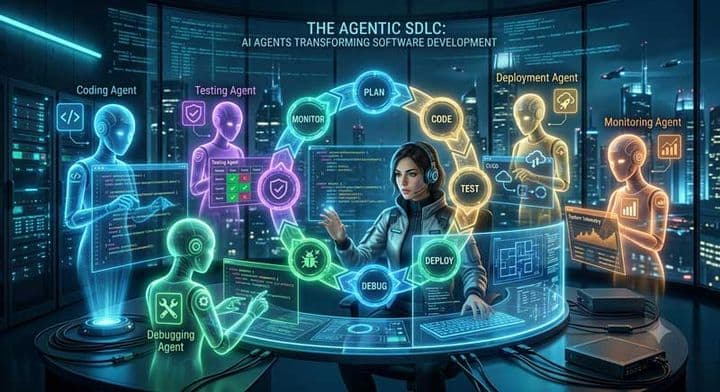
That paradigm is currently undergoing a radical transformation. We are entering the era of the Agentic Software Development Lifecycle (SDLC), where AI agents—autonomous systems capable of reasoning, planning, and executing tasks across multiple steps—are becoming active participants in the engineering process.
The Agentic SDLC: Beyond Autocomplete
Unlike static AI assistants that respond to individual prompts, AI agents operate with a specific goal in mind. You set the intent—such as "fix this production bug" or "refactor this module"—and the agent autonomously reads the codebase, traces execution, writes tests, implements the fix, and opens a pull request.
Here is how AI agents are reshaping every phase of the SDLC:
1. Planning and Analysis
AI agents transform vague requirements into structured technical specifications. By analyzing existing documentation, Jira tickets, and codebase context, agents can identify dependencies, predict potential bottlenecks, and map out the project scope before a single line of code is written. They effectively turn engineers into "conductors" who orchestrate the system architecture rather than "violinists" who manually play every note.
2. Coding and Development
Coding agents can now handle complex feature implementation across multiple files. Rather than just suggesting a snippet, they can implement full workflows, handle refactoring, and maintain cross-repository awareness. Because they understand the broader codebase, they ensure that new features align with established design patterns and coding standards.
3. Testing and Debugging
Testing is arguably the most dramatic beneficiary of agentic workflows. Agents can autonomously generate failing tests to reproduce a reported bug, iteratively modify application logic until the test passes, and re-run the entire test suite. This shifts testing from a periodic, scheduled checkpoint to a continuous, background validation process.
4. Documentation and Review
Agents serve as tireless code reviewers. They automatically scan pull requests for vulnerabilities, performance issues, and adherence to best practices. Furthermore, they keep documentation in sync with the codebase by automatically generating or updating API references and README files whenever code changes are merged.
5. Deployment and Monitoring
In the deployment phase, agents manage CI/CD pipelines autonomously. They handle environmental configurations, validate infrastructure-as-code (IaC) templates, and monitor production systems in real-time. If an anomaly is detected, an agent can initiate a rollback or suggest a self-healing patch, significantly reducing the "mean time to recovery" (MTTR).
Current Capabilities and Strategic Challenges
While the potential is immense, moving from pilot programs to production-ready agentic systems is fraught with challenges.
Current Capabilities
1. Multi-Agent Orchestration: Modern architectures have moved beyond single agents. Specialized teams—such as a "researcher agent," a "coding agent," and an "analyst agent"—collaborate to solve complex problems, mirroring human team structures.
- 2. Context-Aware Reasoning: Advanced models now maintain massive context windows, allowing them to understand the "operating picture" of an entire organization—including code, documentation, and infrastructure logs—simultaneously.
Core Challenges
- 1. Reliability and Non-Determinism: LLM-based systems can produce different results from the same input. This unpredictability makes traditional, deterministic testing methods difficult to apply.
- 2. Security and Governance: AI agents expand the attack surface. Without rigorous role-based access control, an agent could be manipulated via prompt injection to delete data or leak sensitive credentials.
- 3. Cost and Complexity: Orchestrating multi-agent systems is resource-intensive. High token usage and complex reasoning chains can lead to unpredictable infrastructure costs that, if unmanaged, erode the productivity gains.
Future Trends: What’s Next?
As we look toward the remainder of 2026 and beyond, three trends will define the agentic SDLC:
- 1. The Autonomy Spectrum: Organizations are shifting from "human-in-the-loop" assistance to "orchestrator-level" autonomy. We are moving toward a future where agents perform the heavy lifting, and humans provide high-level intent, oversight, and governance.
2. Nondeterministic Design Patterns: To manage the unpredictability of AI, companies are adopting new design patterns. This includes wrapping generative components in "filter and approval" layers and building systems that are verifiable by design to prevent cascading failures.
3. AI-Native Governance: As regulations tighten around software supply chains, AI agents will increasingly be responsible for their own compliance. We will see the rise of autonomous agents specifically tasked with ensuring that all code, dependencies, and deployment processes meet stringent regulatory and security standards.
Conclusion
The transition to an agentic SDLC is not just about making individual developers faster; it is about systemic transformation. By offloading routine, repetitive, and time-consuming tasks to intelligent agents, engineering teams can refocus their efforts on what truly matters: high-level system design, strategic problem-solving, and innovative product development.
The organizations that thrive in this new era will be those that treat AI agents as full-fledged team members, investing in the governance, orchestration, and continuous monitoring required to work effectively alongside them.