10 Signs Your Business Needs Custom Software Development
Learn the 10 warning signs that indicate your business has outgrown spreadsheets, manual processes, and disconnected software. Discover when custom software development can improve automation, reporting, scalability, customer service, and data security.

Ahom Jawadur Rahman
11 Aug, 2026
Custom Software Development, Business Software, Software Development Bangladesh
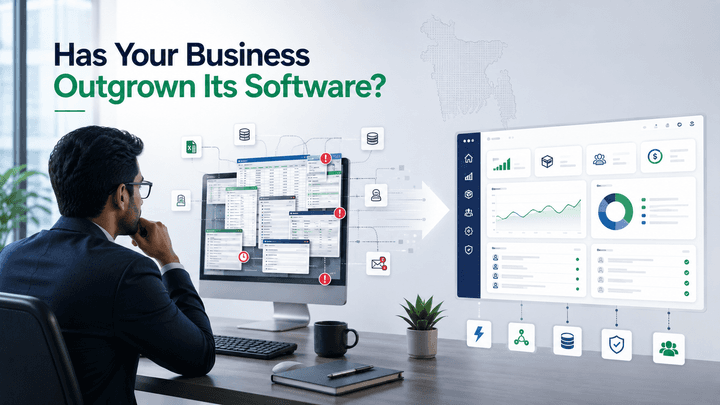
A business needs custom software development when spreadsheets, paper records, or a mix of disconnected tools can no longer keep up with the accuracy, speed, and reporting that daily operations demand. This usually shows up as specific, recognizable symptoms, not a single sudden failure. The ten signs below cover the most common ones, along with the operational reason each points to a custom solution rather than another off-the-shelf fix.
1. Your Team Repeats the Same Manual Work Every Day
Manual data entry, retyping the same order into three different systems, or copying figures from one spreadsheet to another is a direct sign that a process needs automation. Every manual re-entry point is also a point where human error can creep in.
Custom software removes this by connecting the systems directly, so data entered once flows automatically to every place it's needed. This is the core idea behind business process automation: replacing repeated manual steps with a single automated workflow.
2. Excel Spreadsheets Are Running Core Parts of the Business
Spreadsheets work well for small, simple calculations. They break down when multiple people need to update the same data at once, when formulas get overwritten by mistake, or when a file becomes too large to load quickly.
A custom-built system replaces scattered spreadsheets with a single, structured database that enforces rules (a required field cannot be left blank, a discount cannot exceed a set limit) that a spreadsheet cannot reliably enforce on its own.
3. Data Errors and Mismatches Keep Turning Up
If sales figures in one report don't match the numbers in another, or if a customer's contact details are different across two systems, the root cause is usually duplicate, unsynced data sources. Every disconnected tool used to store the same information is another chance for the records to drift apart.
Custom software solves this with a single source of truth: one database that every department reads from and writes to, so a customer's record, an order's status, or a product's stock count is the same everywhere it's viewed.
4. You Can't Get a Real-Time Report When You Need One
If producing a sales report, an inventory count, or a cash flow summary means manually pulling numbers from several places and compiling them by hand, decision-making slows down. By the time the report is ready, the numbers may already be outdated.
A custom system with built-in reporting and dashboards pulls live data automatically, so a business owner can check current performance in seconds rather than waiting for someone to assemble it manually. This is one of the most immediate returns of enterprise software development for a growing business.
5. None of Your Current Tools Talk to Each Other
Many small businesses in Bangladesh run on a patchwork of tools: one for accounting, one for inventory, one for staff attendance, and a spreadsheet for everything else. When these systems don't share data, staff spend time transferring information between them manually.
Custom software integrates these functions into one platform, or connects existing tools through APIs, so information moves automatically between accounting, inventory, and sales without manual transfer. This is typically the point where a business starts evaluating custom ERP software rather than adding another standalone app.
6. Growth Is Being Held Back by Your Own Systems
A system that worked fine for a handful of orders a day can become a bottleneck once order volume, staff count, or product range grows. Signs include longer processing times, more staff needed just to keep existing tools running, or a system that visibly slows down under higher load.
Custom-built platforms are designed around the business's actual growth plans, so capacity and features scale with the business instead of requiring a full replacement every time it grows. This is a core reason mid-sized businesses move toward dedicated business software solutions instead of staying on generic tools.
7. Customer Service Is Slow Because Records Are Scattered
When a customer calls with a question and the support team has to check three different systems, or a paper file, to find their order history, response time suffers. Scattered records also make it harder to spot a repeat issue affecting multiple customers.
A custom customer relationship system consolidates order history, communication logs, and account details into a single view, so support staff can answer a query immediately instead of searching across systems.
8. Off-the-Shelf Software Almost Fits, But Not Quite
Generic software is built for a broad market, not for one specific business. It's common to end up working around a tool's limitations (renaming fields to match a different workflow, or maintaining a separate spreadsheet for the one feature the software doesn't support).
Custom software is built directly around how the business actually operates, rather than asking the business to adapt to a generic tool. In the case of a retail or wholesale operation, a purpose-built system like Dokani, built specifically for shop management in Bangladesh, illustrates the difference software tailored to a specific business type makes compared with a generic, one-size-fits-all tool.
9. Inventory or Stock Tracking Is Inaccurate or Delayed
If stock counts in the system don't match what's actually on the shelf, or if updating inventory means a manual count at the end of each day, the business is exposed to stockouts, overselling, or tied-up capital in excess stock.
A custom inventory system updates stock levels automatically as sales and purchases happen, giving an accurate, real-time count rather than a daily estimate. For businesses handling physical goods, this is usually one of the clearest and most measurable returns on a software investment.
10. Data Security and Access Control Are a Growing Concern
Spreadsheets and shared folders typically offer no real control over who can view or edit sensitive data such as payroll, supplier pricing, or customer information. As a team grows, this becomes harder to manage and easier to get wrong.
Custom software supports role-based access control, so each staff member only sees the data relevant to their role, with an audit trail showing who changed what and when. This level of control is difficult to achieve consistently with spreadsheets or generic file-sharing tools.
Choosing the Right Custom Software Development Partner
Recognizing these signs is the first step. Solving them requires a software development company in Bangladesh with direct experience translating operational problems like these into working systems, rather than a generic template repackaged for every client.
IT Lab Solutions is one example of a company that builds custom software, from business websites to enterprise-level systems, around a client's actual operational needs rather than a fixed product. The right partner will start by understanding which of the signs above apply to a specific business, then design a solution around that, rather than starting the conversation with a product to sell.
Summary Checklist
- Repeated manual data entry across systems
- Core operations still running on spreadsheets
- Recurring data mismatches between departments
- No access to real-time reports
- Disconnected tools that don't share data
- Growth outpacing current system capacity
- Slow customer service due to scattered records
- Off-the-shelf software that doesn't fit the workflow
- Inaccurate or delayed inventory tracking
- Limited control over data access and security
A business showing two or more of these signs is generally past the point where another generic tool will help. At that stage, custom software development addresses the underlying operational problem directly, rather than adding one more disconnected system to work around.