The Ultimate Guide to POS and Shop Management System in Bangladesh
This guide explores how digital POS systems are transforming retail in Bangladesh by replacing manual ledgers with efficient tools for inventory, sales, and credit management. It emphasizes the importance of locally-adapted platforms that prioritize Bangla language support, offline functionality, and integration with domestic payment systems to effectively meet the needs of Bangladeshi shop owners.

Abhishek Chowdhury
05 Sep, 2026
POS Systems Bangladesh, Shop Management Software
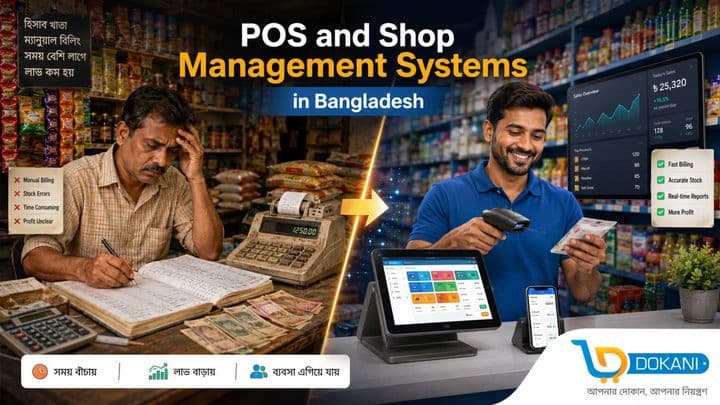
If you run a retail shop in Bangladesh, you know the struggle. Handwritten ledgers, manual billing, and endless inventory headaches. You're not alone—millions of shop owners across the country still rely on traditional methods that are time-consuming and prone to errors . But here's the good news: the digital revolution has finally arrived for small businesses. From mobile-first POS apps to affordable IoT solutions, Bangladesh now has more options than ever to digitize your shop.
This guide covers everything you need to know about POS and shop management systems in Bangladesh—what's available, how they work in our unique market context, and which one is right for your business.
What is a POS System and Why Does Your Shop Need One?
A Point of Sale (POS) system is more than just a fancy calculator. It's the nerve center of your retail operations—handling sales, inventory tracking, customer management, and financial reporting in one integrated platform.
Think of it this way: while a cash register just records sales, a modern POS system helps you understand your business. It tells you which products sell best, which customers buy most, and whether you're actually making a profit.
For Bangladeshi shop owners, the benefits are particularly compelling:
- Eliminate manual errors: No more mistakes in billing or stock counting
- Save hours each day: Fast billing means shorter queues and happier customers
- Track your business remotely: Monitor sales even when you're not at the shop
- Manage credit sales: Keep track of customer dues without the mental burden
Generate instant reports: Know your profit and loss with a single click
The Bangladesh Context: Why Local Solutions Matter
Here's what makes the Bangladesh market unique—and why international POS systems often fall short in our country:
Language and literacy: Many shop owners and staff are more comfortable with Bangla than English. A system that doesn't support Bangla creates a barrier to adoption .
Internet connectivity: While 4G coverage has improved dramatically, many areas still face patchy connectivity. Offline functionality is non-negotiable for many shops.
Mobile-first population: Most small business owners in Bangladesh manage their operations from smartphones rather than desktop computers.
Affordability: The typical international POS system can cost thousands of dollars—simply out of reach for a neighborhood grocery store or clothing shop.
Credit culture: "Dokan" (credit sales) is deeply embedded in Bangladeshi retail. Any system must handle customer due management effectively.
Payment integration: bKash, Nagad, and Rocket are the backbone of digital payments in Bangladesh. Integration with these services is essential .
Existing POS and Shop Management Solutions in Bangladesh
The Bangladeshi market has seen a surge of locally-developed POS solutions in recent years. Here's what's currently available:
Smart Dokani
Smart Dokani is a comprehensive retail POS app developed by Smart Software Ltd., based in Dhaka . The app handles sales and purchase management, inventory control, profit/loss reporting, and even employee payroll. A standout feature is its offline capability—you can continue selling without internet and sync data later . The system also includes an online ordering feature, allowing customers to browse and purchase products from your shop's digital catalog.
Key features: Cloud backup, barcode scanning, multi-user support, customer credit management, and layaway programs .
AmarSolution
Founded in 2018, AmarSolution offers specialized POS software for different retail verticals including fashion, restaurants, supermarkets, electronics shops, medical stores, and wholesale operations . The system is fully online, allowing access from any device anywhere . The company highlights easy operation, free customization support, and 24/7 customer service as key advantages .
Key features: Vertical-specific solutions, multi-branch management from one platform, and a built-in CRM system .
Hishabee Business Manager
Positioned as Bangladesh's #1 platform for mom-and-pop shops, Hishabee claims to serve over 600,000 unbanked small businesses . The platform is designed specifically for the Bangladeshi market with a mobile-based POS system that helps manage cash flow, sales, expenses, inventory, and accounts books .
Key features: Mobile-based POS, personal online shop creation, due list and reminders, expense tracking, multi-language support, and barcode printing .
BanglaPOS
Perhaps the most innovative recent development is BanglaPOS—a low-cost, IoT-based system designed for small wholesale businesses . Developed with Bangladesh's specific constraints in mind, the prototype costs only 1,600 BDT—dramatically cheaper than conventional POS systems . Built around an ESP32 microcontroller, it features a 2.8-inch TFT display with custom Bangla font rendering and supports both Bangla input and output .
Key features: Extremely affordable, Bangla language support, real-time transaction display, inventory shortage alerts, and remote monitoring via cloud dashboard .
Becho
Incubated at BRAC University's Centre for Entrepreneurship Development, Becho is a mobile-first business management platform designed for CMSMEs (cottage, micro, small, and medium enterprises) . The platform integrates inventory, orders, payments, delivery, CRM, and analytics into a single digital system—addressing the critical lack of structured business data among Bangladesh's 300,000+ online sellers .
Key features: Data-driven business insights, integrated CRM and delivery management, digital footprint creation for small businesses .
Dokani by IT Lab Solutions
IT Lab Solutions offers "Dokani" as a retail management solution for small and medium retail operations . The system handles inventory, sales, and customer data management in an integrated platform . IT Lab Solutions also provides integration with major Bangladeshi payment platforms including bKash, Nagad, and Rocket .
Key features: Retail-focused management, local payment platform integration, part of a broader ecosystem of business solutions including education management (Pathshala) and installment tracking (3S Manager) .
How POS Systems Work in the Bangladesh Scenario
Let's walk through how a POS system actually helps a typical Bangladeshi shop run better:
Billing and Checkout
Instead of calculating totals on paper or a basic calculator, the POS system automatically calculates totals, applies any discounts, and generates a professional receipt. For shops with high customer volume—like a busy grocery store in Dhaka—this can cut checkout time by 70%.Inventory Management
Every sale reduces stock automatically. When inventory drops below a threshold, the system alerts you to reorder. No more last-minute panic about running out of popular items.Supplier Management
Track which suppliers provide which products, manage purchase orders, and maintain supplier contact information in one place.Customer Management
Build a customer database that includes purchase history and credit limits. For shops that regularly give credit to regular customers, this is invaluable—you'll know exactly who owes what.Financial Reporting
Know your profit and loss on any given day, week, or month. See which products are making the most money and which are just taking up shelf space.Multi-Branch Management
For shops with multiple locations, cloud-based systems allow you to monitor all branches from a single dashboard—seeing total sales, inventory levels, and performance across your entire business.
Choosing the Right POS System: A Decision Framework
With so many options, how do you choose? Consider these factors:
| Factor | What to Consider |
| Business Type | Restaurant, retail, wholesale, or grocery? Choose a system designed for your vertical |
| Internet Access | If connectivity is unreliable, prioritise systems with offline mode |
| Technical Comfort | If your staff is not tech-savvy, look for systems with a Bangla interface |
| Budget | One-time cost vs. monthly subscription—calculate total cost over 2-3 years |
| Payment Integration | Ensure compatibility with bKash, Nagad, Rocket if you accept digital payments |
| Scalability | Will the system grow with your business? Can it handle multiple branches? |
| Customer Support | What support channels are available? Emergency support? |
The Future of Shop Management in Bangladesh
The trend is clear: Bangladesh's retail sector is digitising rapidly. Several developments point to an exciting future:
International entry: British fintech VALT recently launched in Bangladesh, bringing UK-developed POS solutions adapted for the local market. This indicates growing international interest in Bangladesh's digital economy.
Government support: Bangladesh Bank is actively working to expand financial inclusion, with initiatives that support digital transformation of merchants.
Democratizing technology: Solutions like BanglaPOS demonstrate that even small shops with limited budgets can now access digital tools.
Integration ecosystem: POS systems are increasingly integrating with payment gateways, delivery services, and e-commerce platforms—creating a seamless digital retail environment.
Key Takeaways
- Bangladesh-specific solutions exist for every budget and business type—from low-cost IoT systems to comprehensive cloud-based platforms
- Mobile-first approach is critical—most shop owners and managers prefer smartphone-based management over desktop software
- Bangla language support is a differentiator—look for systems that support Bangla interface for easier adoption by staff
- Offline functionality matters—don't assume perfect internet connectivity, especially outside major cities
- Integration with local payment systems (bKash, Nagad, Rocket) is essential for digital payment adoption
Clear cost structure—understand whether you're paying a one-time fee, monthly subscription, or per-transaction charge
Frequently Asked Questions
1. What's the cheapest POS system available in Bangladesh?
The BanglaPOS prototype costs only 1,600 BDT, making it one of the most affordable options. However, for more comprehensive features, subscription-based services like Smart Dokani and Hishabee offer monthly plans suitable for small businesses.
2. Can I use a POS system without internet?
Yes. Several solutions like Smart Dokani offer offline mode where you can continue selling without internet and sync data later when connectivity is restored.
3. Is there POS software available in Bangla?
Yes. BanglaPOS is specifically designed with Bangla support for both input and output. Many other solutions like Hishabee also offer multi-language support including Bangla.
4. Can I manage multiple branches from one system?
Yes. Solutions like AmarSolution and Smart Dokani allow you to manage multiple branches from a single platform, viewing consolidated reports and tracking performance across locations.
5. How do POS systems integrate with bKash or Nagad?
Most local POS solutions—including those from IT Lab Solutions—offer integration with major payment platforms like bKash, Nagad, and Rocket, enabling seamless digital payment acceptance.
6. Do I need special hardware for a POS system?
It depends on the solution. Some work entirely on smartphones; others require specialized hardware like receipt printers, barcode scanners, and display screens. BanglaPOS uses an ESP32-based custom hardware setup.
7. How long does it take to implement a POS system in a shop?
Most cloud-based solutions can be set up within a day. Hardware-based systems may take longer. Staff training typically takes a few days to become comfortable with the new system.