How PATHSHALA is building a smarter student journey with EdTech
From admission to career, PATHSHALA connects every step of a student's journey. Bringing students, teachers, guardians and institutions closer through smarter digital education.

Debojyoty Chowdhury
23 Aug, 2026
EdTech
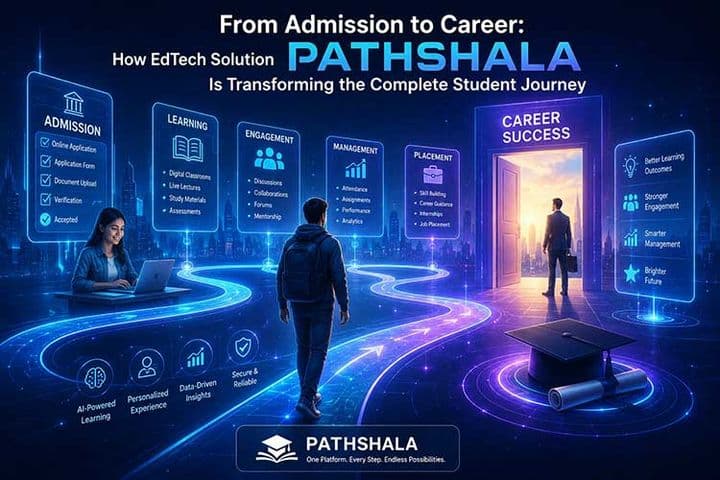
Think about a student's journey through a school or college. It starts with an admission form. Then come the first classes, daily attendance, examinations, results, library books, tuition fees, notices, certificates and, eventually, the question every student and guardian cares about most: What comes next?
For years, many of these activities have been handled separately—with paper files, registers, spreadsheets, phone calls and long administrative processes. But education is changing.
Today, technology is helping institutions bring these scattered activities together and create a more connected experience for students, teachers, guardians and administrators.
In Bangladesh, PATHSHALA, an EdTech solution powered by IT Lab Solutions Limited, is contributing to this transformation. With millions of users and hundreds of schools and colleges connected to its ecosystem, PATHSHALA is helping institutions move toward a smarter and more connected way of managing education.
But perhaps the most interesting part of this transformation is not the technology itself.
It is what the technology gives people back—time, information, convenience and better communication.
A Student's Journey Begins With Admission
Admission may look like a simple administrative process, but it is actually the beginning of a student's relationship with an institution. There are forms to complete, information to collect, documents to organize and records to maintain. When these activities are handled manually, admission can become a burden for both institutions and families.
A digital admission system changes the experience. Student information can be collected and organized systematically from the beginning. Instead of creating another pile of paperwork, the information becomes part of a student's digital academic record.
And this is where the real value of an integrated system begins. The information collected during admission does not have to disappear into a file cabinet. It can become part of the student's journey throughout their time at the institution.
Then Comes Everyday School Life
After admission, the real journey begins. Students attend classes, teachers take attendance, assignments are given, examinations are held and academic performance is recorded.
For teachers and staff, however, there is a lot of work happening behind the scenes.
Attendance has to be recorded. Records have to be updated. Reports need to be prepared. Information has to be shared with the administration and, sometimes, with guardians.
These tasks may seem small individually, but together they can consume a significant amount of time.
Digital attendance and student management can take away much of this repetitive work.
And that matters because a teacher's time is valuable.
Every hour saved from administrative work is an hour that can potentially be spent teaching, discussing a difficult lesson, helping a struggling student or simply listening to a student's concerns. Technology, in this sense, isn't replacing the teacher. It is giving the teacher more time to be a teacher.
Keeping Guardians in the Loop
There was a time when a guardian often had to wait for a school meeting, make a phone call or ask their child to find out what was happening at school.
Today, expectations are different.
Parents and guardians want to know what is happening in their children's education—and they want that information quickly.
Is the student attending classes regularly?
When is the next examination?
How did the student perform?
Has the institution published an important notice?
Has a payment been recorded?
Digital communication can make these updates much easier to deliver. Through notifications and connected communication, guardians can receive important information without having to depend entirely on physical notices or repeated phone calls.
It creates a simple but meaningful change:
The guardian becomes more connected to the student's educational journey.
Results Shouldn't Be a Waiting Game
For students, examination results can be one of the most anticipated moments of the academic year. For institutions, however, preparing those results can be a huge administrative exercise.
Marks need to be collected, checked, organized and published. Records need to be maintained. Students and guardians need access to the final results.
Digital result management can make this process considerably more organized.
Instead of relying heavily on manual calculations and paperwork, institutions can manage academic results through a structured digital system.
Students can get access to their results more quickly. Guardians can stay informed. Teachers and administrators can spend less time dealing with repetitive paperwork.
More importantly, digital academic records can help institutions understand student performance over time.
A result is not just a number. It can tell a story about where a student is doing well, where they may need additional support and how their academic journey is progressing.
One Platform Can Connect Many Pieces
This is where an integrated solution like PATHSHALA becomes particularly valuable.
A school or college doesn't operate through one process. It operates through many interconnected processes.
Admission is connected to student information.
Student information is connected to attendance.
Attendance and academic activities are connected to performance.
Performance is connected to examinations and results.
Financial activities are connected to payments.
Institutional communication is connected to students and guardians.
Library services are connected to learning.
Certification is connected to a student's academic history.
When these activities are managed separately, information can become fragmented.
When they are connected through a digital ecosystem, the institution can work in a more coordinated way.
PATHSHALA brings together modules covering areas such as admission, student management, attendance, examination and result management, notifications, guardian communication, library automation, digital payments and certification.
The real benefit is not simply having all these features.
It is having them work together around the student.
Making Life Easier for Teachers and Staff
There is another side of digital transformation that is sometimes overlooked.
We often talk about what technology does for students. But technology can also make a tremendous difference to the people working behind the scenes.
Teachers and administrative staff spend countless hours managing records and routine tasks.
If a digital platform can reduce some of that workload, the benefit goes beyond efficiency.
It can reduce frustration.
It can reduce repetitive work.
It can reduce the chances of manual errors.
And most importantly, it can give people back some of their valuable time.
For an educational institution, that is a meaningful improvement.
A smarter system should ultimately allow people to spend more time doing the work that requires human judgment, empathy, creativity and knowledge.
Digital Payments Bring Another Layer of Convenience
Financial management is an unavoidable part of running an educational institution.
Fees need to be collected. Payments need to be recorded. Guardians need information about their financial obligations. Institutions need accurate records.
Digital payment systems can simplify this entire process.
Instead of depending entirely on manual records and physical transactions, institutions can manage payment information digitally while making the experience more convenient for guardians.
It is another example of a small technological improvement that can make a noticeable difference in everyday life.
The Library Is Becoming Smarter Too
A library may appear very different from a digital education platform, but it remains an important part of a student's learning journey.
Managing books, records and borrowing activities manually can become complicated as an institution grows.
Library automation can help institutions organize these activities more efficiently.
For students, it means a smoother experience.
For library staff, it means less repetitive record keeping.
And for institutions, it means better management of one of their most important learning resources. What Happens at the End of the Journey?
Eventually, every student's school or college journey reaches an important milestone: certification.
A certificate is more than a piece of paper
It represents years of learning, examinations, hard work and personal growth.
Managing certification digitally can help institutions maintain academic records more systematically and make the process more efficient.
But certification is not really the end.
It is a bridge to what comes next.
Higher education.
Professional training.
Employment.
Entrepreneurship.
A career.
From Managing Students to Understanding Students
This is perhaps where the future of EdTech becomes most exciting.
Traditionally, educational institutions have focused heavily on managing students.
Who enrolled?
Who attended?
What marks did they receive?
Did they pay their fees?
Did they pass?
Digital technology opens the door to a broader question:
How can we better understand and support a student's journey?
When academic and administrative information is connected, institutions can gain a clearer picture of student progress.
Attendance patterns, academic performance and other relevant information can help educators identify where students may need additional attention and support.
The ultimate goal should not be to collect more data.
It should be to use information more intelligently to help students move forward.
A Bigger Change Is Taking Place in Bangladesh
Bangladesh has a large and diverse education system. Managing hundreds of educational institutions and millions of students is not a small challenge.
Digital transformation can play an important role in making that system more connected.
PATHSHALA's growing ecosystem—connecting hundreds of schools and colleges and serving millions of users across Bangladesh—shows how education technology is moving beyond individual digital tools toward a more integrated approach.
The idea is simple:
A student shouldn't have to experience education as a collection of disconnected processes.
The admission process, classroom experience, attendance, examination, results, communication, payments, library services and certification are all parts of the same journey.
Technology can help bring those pieces together.
The Future of Education Is More Human Than We Think
There is an interesting paradox in education technology.
The more routine work technology can handle, the more time people can spend doing the things technology cannot easily replace.
A teacher can spend more time explaining.
A mentor can spend more time guiding.
A guardian can stay more involved.
An administrator can focus more on improving the institution.
And a student can spend more time learning.
That, ultimately, is what meaningful EdTech should achieve.
PATHSHALA is not simply about turning paper-based processes into digital ones. It is about creating a connected educational environment where students, teachers, guardians and institutions can work together more easily.
From the first admission record to the final certificate—and from classroom learning to the possibilities of a future career—the student's journey can become more connected, more transparent and more efficient.
And as hundreds of educational institutions across Bangladesh continue to embrace digital transformation, solutions like PATHSHALA are helping shape what the next generation of education can look like.
Not an education system where technology replaces people.
But one where technology gives people more time to do what matters most: educate, guide, communicate and inspire.