How to Choose the Best IT Company in Bangladesh: A Complete Buyer's Guide (2026)
Learn how to choose the right IT company in Bangladesh by evaluating experience, portfolio, technology, communication, pricing, and after-sales support. This guide provides a practical checklist to help businesses reduce risks and make a confident software investment.

Ahom Jawadur Rahman
11 Aug, 2026
IT Company Bangladesh, Software Development, IT Services Bangladesh
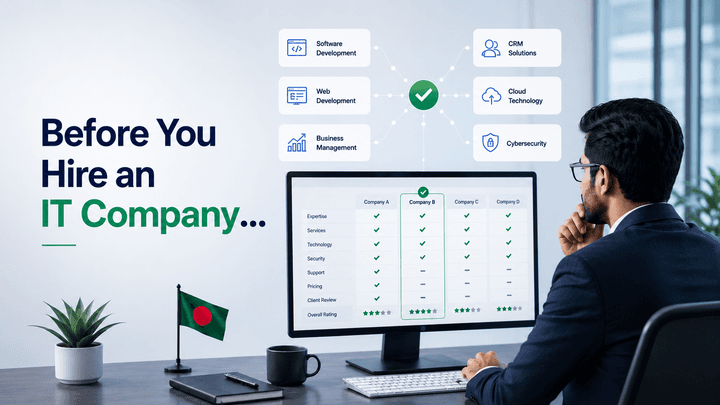
Choosing the wrong IT company can cost months of development time, unexpected expenses, and a system that fails when your business grows. A custom software project for a manufacturing firm has different requirements than a website for a retail startup, so "best" depends on fit as much as reputation. This guide breaks down the exact criteria a business owner should check before signing a contract with any software company in Bangladesh.
Why Choosing the Best IT Company in Bangladesh Matters More Than Ever
Bangladesh's digital economy has expanded rapidly, and small and medium enterprises, educational institutions, and government offices increasingly depend on software to manage operations. A dynamic website, an inventory system, or a custom application built by a software development company in Bangladesh often becomes core infrastructure, not a one-off purchase.
Because of that, a wrong choice is expensive. A poorly built system creates downtime, security gaps, and repeated rework. A well-matched IT company in Bangladesh, on the other hand, becomes a long-term technical partner rather than a vendor that disappears after delivery.
Check the Company's Industry Experience
Experience is the first and most reliable filter. A software company that has operated for several years has already worked through the technical and operational problems a newer vendor is still learning to solve.
Relevant experience should be checked in two dimensions:
1. Years in operation: longevity signals financial stability and staff retention, both of which affect long-term support.
2. Sector experience: a company that has built systems for education, retail, or finance understands the regulatory and workflow details specific to that sector, which shortens the discovery phase of a project.
A business owner should ask directly: "Have you built something like this before, and can I see it?" A confident answer points to a company with a track record; a vague one is a warning sign.
Assess the Technology Stack and Development Approach
The technology stack determines how a system will perform, scale, and integrate with other tools years after launch. Before selecting a custom software development partner, a business owner should ask what stack will be used and why it fits the project, not just accept a generic answer.
Key questions to raise with any web development company in Bangladesh include:
1. Is the solution built on a modern, actively maintained framework, or an outdated one that will be difficult to find developers for later?
2. Will the code be delivered as fully owned intellectual property, or does the vendor retain control over the codebase?
3. Does the company follow structured development practices: version control, testing, staged deployment, or deliver code in an ad-hoc manner?
A company that can explain its stack choices in plain terms, tied to the client's actual use case, is demonstrating technical accountability rather than reciting buzzwords.
Evaluate Communication and Project Management
Software projects fail as often from poor communication as from poor code. A reliable IT company in Bangladesh should provide a single point of contact, a documented project timeline, and scheduled updates, not sporadic messages when a milestone is already overdue.
Before signing on, a business owner should confirm:
1. How progress will be reported (weekly calls, a shared project board, milestone demos).
2. Who is responsible for approving changes and resolving disputes.
3. What happens when a requirement changes mid-project.
Vendors that resist putting these details in writing tend to be the same ones that later dispute scope, timeline, or cost.
Understand the Pricing Model
Pricing in the IT services market in Bangladesh varies widely, partly because "custom software development" can mean a two-week landing page or a six-month enterprise system. A trustworthy company breaks the cost down by module, feature, or development phase rather than quoting a single lump sum with no explanation.
A buyer should specifically confirm what is included in the price:
1. Design, development, testing, and deployment as separate line items.
2. Whether hosting, domain, and third-party licensing costs are separate from the development fee.
3. Whether post-launch bug fixes are covered, and for how long.
The lowest quote is rarely the cheapest option once maintenance, rework, and downtime are factored in over the life of the system.
Confirm After-Sales Support and Maintenance
A software system needs updates long after launch: security patches, new features, and fixes for issues that only appear once real users start relying on it daily. This is where many otherwise capable software companies in Bangladesh fall short: development is strong, but support fades once the invoice is paid.
Before committing, a business owner should ask for the specific terms of after-sales service: response time for critical issues, whether support is available by phone or only by ticket, and whether a maintenance contract is offered beyond the initial free period.
Why Range of Experience and Long-Term Support Are the Safest Combination
Taken together, these criteria point toward a consistent pattern: the safest choice is usually a company with proven experience across multiple sectors, a portfolio of software that is still actively used by real clients, and a demonstrated commitment to supporting what it builds long after delivery.
IT Lab Solutions, a Sylhet-based IT company, illustrates this pattern. Its product range spans education management software, retail and inventory systems, CRM tools, and custom business websites, covering several of the sectors discussed above rather than a single niche. Its education management platform, Pathshala EIMS, has been deployed across schools and colleges for day-to-day administration, attendance, and result processing, which reflects the kind of live, verifiable case study a buyer should look for rather than take on faith. Companies with this combination (sector breadth, working products in active use, and continued client support) tend to reduce the long-term risk that comes with any software investment.
Frequently Asked Questions (FAQ)
1. How do I choose the best IT company in Bangladesh?
To choose the best IT company in Bangladesh, check its industry experience, previous projects, live portfolio, technology expertise, communication process, pricing transparency, and after-sales support. The right company should understand your business needs and provide a solution that can grow with your organization.
2. What should I check before hiring an IT company in Bangladesh?
Before hiring an IT company in Bangladesh, review its past work, client references, development process, technology stack, pricing structure, source code ownership policy, and maintenance support. These factors help determine whether the company is reliable and suitable for your project.
3. Why is industry experience important when selecting a software company?
Industry experience helps a software company understand specific business workflows, challenges, and requirements. A company that has worked with similar industries can usually deliver better solutions because it already understands common problems and best practices.
4. How much does it cost to hire an IT company in Bangladesh?
The cost of hiring an IT company in Bangladesh depends on the project's complexity, features, technology requirements, development timeline, and support needs. A trustworthy company should provide a clear breakdown of costs instead of offering a vague fixed price without explaining what is included.
5. Why is after-sales support important when choosing an IT company?
After-sales support is important because software requires regular updates, security improvements, bug fixes, and maintenance after launch. A reliable IT company should provide clear support terms, response times, and maintenance options to ensure the system continues working as the business grows.