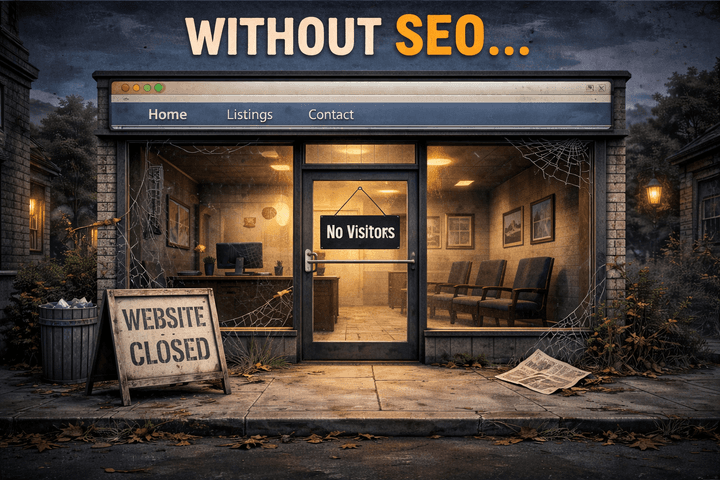
How to Rank on Google as a Local Real Estate Agent
Struggling to get found on Google in Austin, Buffalo, Houston, or Dallas? Learn exactly how local real estate agents rank higher, attract more buyers and sellers, and generate consistent leads online — step by step.

Nusrat Labiba Chowdhury
25 Mar, 2026
Rank on google
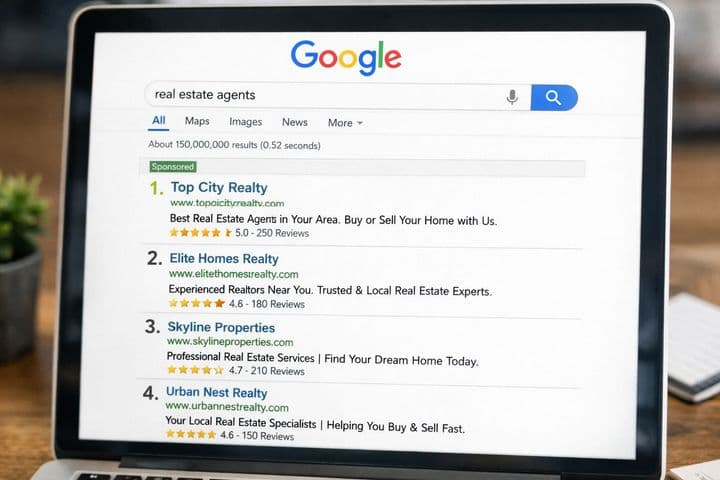
Why Google Is Now the #1 Source of Real Estate Leads
Forget cold calls. Forget door knocking. Forget waiting on referrals.
According to the National Association of Realtors, 100% of Americans who bought a house in 2024 used the internet to search for a home. Showami Every single one.
In 2026, 93% of homebuyers use local search to find properties FlippingBook which means if you are not showing up in local Google results in Austin, Buffalo, Houston, Dallas, or wherever you work, you are invisible to nearly your entire market.
And here is what makes this even more critical Google's Local Pack drives 44% of all local search clicks. Placester Inc That map block with three agents that appears at the top of Google? Nearly half of all searchers click on it before they ever scroll down to regular results.
The agents sitting in that map pack are winning the market. The agents not in it are wondering where their leads went.
So how do you get there? Let's break it down step by step.
Step 1 — Set Up and Dominate Your Google Business Profile
If there is one thing you do after reading this post, make it this.
Your Google Business Profile remains the single most powerful ranking signal, accounting for more than 30% of map pack visibility. Taboola It is free. It is powerful. And most agents either ignore it or set it up halfway.
Here is how to set it up correctly:
Claim your profile Go to business.google.com. Search for your name or agency. Claim it if it already exists, or create a new one.
Choose the right category Select "Real Estate Agent" as your primary category. If you also serve buyers, you can add "Real Estate Consultant" as a secondary.
Fill out every single field
- Business name — use your real name as it appears on your license. Keywords in business names still carry ranking weight, but resist the urge to stuff phrases like "John Smith – Austin Texas Luxury Homes for Sale" - Google's algorithm is tightening against keyword-stuffed titles. Taboola
- Phone number - use a number that is consistent across all platforms
- Service areas - list every city, neighborhood, and zip code you serve. If you work in Austin, add Round Rock, Cedar Park, and Pflugerville too. In Buffalo, add Cheektowaga, Amherst, and Tonawanda
- Business hours keep these accurate and updated
Add photos — lots of them Upload 15 to 20 high-quality photos. Include your headshot, your office, sold listings, local landmarks, and neighborhood shots. Agents who position themselves as community experts — from local school ratings to the best coffee shops build stronger, more lasting client relationships. Placester Inc Your photos should tell that story.
Post weekly updates Google rewards active profiles. Post new listings, share market updates, celebrate closings, and publish local tips every single week. Think of it as a mini social media feed one that directly affects your Google ranking.
Collect and respond to every review The more positive reviews you receive on Google, the more likely you are to appear in the Local Pack for relevant searches. Showami After every closing — in Austin, in Buffalo, in Denver, anywhere — send your client a direct link to leave a review and ask them personally. Make it easy. Make it a habit.
Google weighs reviews heavily when prioritizing businesses in local search, so encouraging reviews can make a big difference. Placester Inc
Step 2 Build a Website That Works for You 24/7
A Zillow profile is not a website. A Facebook page is not a website.
You need a professional website that you own, control, and that Google can read and rank.
Unlike ads that disappear when the budget runs out, SEO keeps working in the background. Your website, content, and local presence start to do some of the heavy lifting for you. Virtuance
Here is what your website absolutely must have to rank in competitive markets like Austin, Buffalo, Houston, or Dallas:
Homepage headline with your location Your homepage title tag should include: Your Name + Real Estate Agent + City, State. For example: "Sarah Johnson - Real Estate Agent in Austin, Texas" or "Mike Carter - Buffalo NY Realtor."
Neighborhood and area pages Create a dedicated page for every area you serve. Examples:
- "Homes for Sale in South Congress, Austin Texas"
- "First-Time Home Buyers Guide to Elmwood Village, Buffalo NY"
- "Luxury Homes in River Oaks, Houston Texas"
- "Best Family Neighborhoods in Plano, Dallas Texas"
Real estate agencies that create neighborhood guides written by someone who clearly knows the area consistently outrank directory sites like Trulia and Zillow for hyper-local searches. Showami That is your advantage as a local agent — use it.
Fast loading speed Google penalizes slow websites. Your site should load in under 3 seconds. Use tools like Google PageSpeed Insights to check.
Mobile-first design Over 60% of real estate searches happen on mobile. If your site is hard to navigate on a phone, you are losing leads before they even read a single word.
Lead capture on every page Every page of your website should have a way for a visitor to contact you — a contact form, a home valuation tool, a schedule-a-call button, or a free buyer/seller guide download. Never let a visitor leave without giving you a way to follow up.
Step 3 Target the Right Keywords (Not the Impossible Ones)
Here is the biggest keyword mistake real estate agents make — they try to rank for "real estate agent" or "homes for sale."
You will never beat Zillow, Realtor.com, and Trulia for those terms. They have million-dollar SEO budgets.
But you can beat them on hyper-local terms. Local SEO works best with geo-modified keywords like city, zip code, and neighborhood phrases combined with intent terms — such as "homes for sale in Austin TX" or "best neighborhoods in Buffalo NY." These signal clear local intent to search engines and connect you with nearby searchers. AgentUp
Here is a breakdown of the keywords that win for local agents:
High-intent service keywords (use on your website pages):
- Best real estate agent in Austin Texas
- Sell my house fast in Buffalo New York
- Buy a home in Houston Texas
- Top rated realtor in Dallas Texas
- Real estate agent near me Denver Colorado
- Homes for sale in Charlotte North Carolina
First time home buyer agent in Nashville Tennessee
Long-tail question keywords (use in your blog posts):
- How much does a house cost in Austin Texas in 2026?
- Is now a good time to buy a home in Buffalo NY?
- Best neighborhoods for families in Houston Texas
- How to sell my house fast in Dallas without a realtor
- What to look for when hiring a real estate agent in Denver Colorado
- How long does it take to close on a house in Nashville Tennessee
Long-tail keywords capture specific intent and lower competition — they often bring more qualified visitors who are closer to making a decision. AgentUp A buyer searching "3-bedroom homes near downtown Austin under $400k" is much closer to signing a contract than someone just browsing "homes for sale."
Step 4 — Publish Local Content That Makes Google Trust You
Google does not just rank websites. It ranks authority. And authority is built through consistent, locally relevant content.
One well-written blog post per week targeting a specific keyword in your market puts you miles ahead of 90% of agents in Austin, Buffalo, Houston, or anywhere else.
Here are proven blog topics for any US real estate market:
Market updates (publish monthly):
- The Austin Texas Housing Market Report — March 2026
- What Is Happening to Home Prices in Buffalo NY Right Now?
- Is Houston Texas a Buyer's or Seller's Market in 2026?
Neighborhood guides (publish as evergreen pages):
- The Honest Guide to Living in East Nashville, Tennessee
- Best Neighborhoods in Denver Colorado for Young Professionals
- Moving to Dallas Texas? Here Are the 7 Best Suburbs for Families
Buyer and seller guides:
- First-Time Home Buyer's Complete Guide to Austin Texas
- How to Sell Your Home in Buffalo NY Without Leaving Money on the Table
- 10 Things to Know Before Buying a Home in Houston Texas
Local lifestyle content:
- Best School Districts in Charlotte, North Carolina (2026 Guide)
- Moving From NYC to Austin Texas — What Nobody Tells You
- Cost of Living in Buffalo NY vs Austin TX — Honest Comparison
Every one of these posts builds what SEO professionals call topical authority — the signal that tells Google you are the most knowledgeable, trusted real estate expert in your specific market.
Step 5 — Build Your Local Citation Network
A citation is any mention of your business name, address, and phone number — also called NAP — on another website across the internet.
NAP citations are a huge deal when it comes to local SEO. The more websites that list your company's NAP correctly, the more confident Google is that those details are correct — and that you are a legitimate business worth sending searchers to. Showami
Make sure your information is listed — and identical — across all of these:
- Zillow and Realtor.com (yes, even though they compete with you for traffic)
- Yelp
- Bing Places
- Apple Maps
- Nextdoor
- Local chamber of commerce websites (Austin Chamber, Buffalo Niagara Partnership, Houston First, etc.)
- HomeAdvisor and Angi
- Facebook and LinkedIn business pages
One inconsistency — a different phone number here, an old address there — weakens your local authority. Audit your listings and clean up any mismatches.
Step 6 — Get Serious About Reviews
35% of people say a real estate agent's reputation is the most important factor when choosing a realtor to sell their home — according to NAR's study. Showami
And in 2026, reputation lives on Google.
An agent in Austin with 60 five-star reviews will outrank an agent with 8 reviews almost every time regardless of experience or years in the business.
Your review strategy is simple:
- Ask every single client after every single closing
- Send them a direct link, do not make them search for your profile
- Respond to every review, positive or negative it signals to Google that you are active and engaged
- Do not offer incentives — Google's guidelines prohibit this and it can get your profile penalized
A simple message to send after closing:
"It was such a pleasure working with you. If you have 60 seconds, an honest Google review would mean a lot to me — and it helps other buyers and sellers in [City] find the right agent. Here is the direct link: [your review link]."
Short. Personal. Effective. Send it every time without fail.
Step 7 — Track What Is Working and Double Down
You cannot improve what you do not measure.
Once your Google Business Profile is active, your website is live, and your content strategy is running — track these numbers every month:
- Google Business Profile views — how many people are seeing your profile in search
- Website traffic from Google — use Google Search Console (free) to see which keywords are bringing visitors
- Keyword rankings — are you moving up for "real estate agent Austin Texas" or "homes for sale Buffalo NY"?
- Leads generated — how many contact form submissions, calls, or DMs are coming from organic search?
- New Google reviews — are you consistently adding fresh reviews each month?
Double down on what is working. Cut what is not. SEO is not a set-it-and-forget-it strategy — it is an ongoing system that compounds over time.
How Long Does This Take to Work?
This is the question every agent asks.
The honest answer — most agents who follow this system start seeing meaningful movement in 30 to 60 days and strong, consistent results within 3 to 6 months.
The agents dominating Google searches in Austin, Buffalo, Houston, and Dallas today did not build that overnight. But they also did not need years. They just started, stayed consistent, and let the system compound.
The agents who wait? They watch competitors take their market — one search at a time.
The Bottom Line
Ranking on Google as a local real estate agent in 2026 comes down to seven things:
- A complete, active Google Business Profile
- A professional website with local keyword optimization
- Hyper-local keyword targeting in your city and neighborhoods
- Consistent, locally relevant blog content
- A strong citation network across directories
- A steady stream of Google reviews
- Monthly tracking and optimization
- None of this requires a big budget. None of it requires going viral. It just requires showing up — consistently, correctly, and in the right places.
- The buyers and sellers in Austin, Buffalo, Houston, Dallas, Denver, Charlotte, Nashville, and every other market across the US are already searching Google for an agent right now.
- The only question is — are they finding you?