What Is Agentic AI? A Simple Explanation for Non-Tech People
You do not need to be technical to use it. You just need to know what you want. The AI handles the rest.

Nusrat Labiba Chowdhury
29 Mar, 2026
Agentic AI
Introduction
You have probably heard the word "AI" so many times this year that it has started to lose meaning.
ChatGPT. Gemini. Claude. Copilot. AI this, AI that.
But lately, a new phrase keeps showing up — Agentic AI. And if you are not in tech, chances are it sounds like just another buzzword people throw around in meetings to sound smart.
It is not.
Agentic AI is genuinely different from everything that came before it. And understanding it — even at a basic level — could change how you think about your work, your business, and your time.
This article explains it in plain English. No jargon. No code. Just a clear picture of what Agentic AI is and why it matters to you right now.
First — What Is "Regular" AI?
Before we get to Agentic AI, let us quickly settle what AI has been until now.
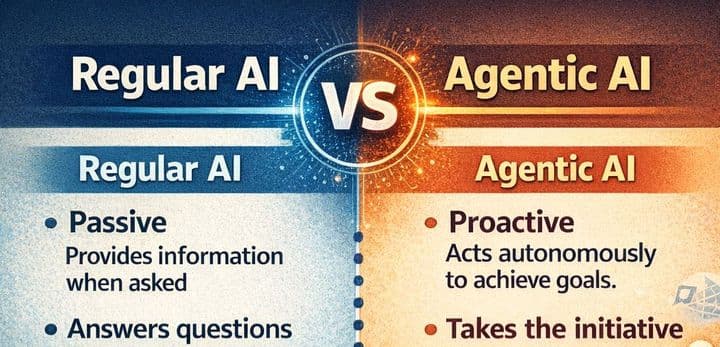
The AI most people use today is reactive. You ask it something, it answers. You give it a task, it does that task. Then it stops and waits for you again.
Think of it like a very smart search engine that can also write.
- You type: "Write me a product description for this item."
- It writes the description.
- Done. It waits.
This is powerful. But it is still you doing most of the thinking. You are still the one deciding what to ask, when to ask it, and what to do with the answer.
Agentic AI changes that equation completely.
So What Is Agentic AI?
Here is the simplest way to put it:
Regular AI responds. Agentic AI acts.
Agentic AI is an AI that can take a goal — not just a single question — and figure out all the steps needed to reach that goal on its own. It makes decisions, uses tools, checks results, and keeps going until the job is done.
You do not guide it step by step. You tell it what you want, and it handles the how.
The Best Analogy: Employee vs. Calculator
Imagine you need to find new clients for your business.
With regular AI, you ask it to write a cold email. It writes the email. You copy it, paste it into your email tool, find the contact, hit send, wait, follow up manually — all of that is still on you.
With Agentic AI, you say: "Find 50 potential clients in the healthcare space, write personalized outreach emails for each one, send them, and follow up with anyone who does not reply within three days."
Then you walk away.
The AI agent finds the contacts, personalizes each message, sends the emails, tracks responses, and handles the follow-up — all without you touching anything.
That is the difference. A calculator needs you to press every button. An employee understands the goal and figures out the buttons themselves.
How Does It Actually Work?
Agentic AI runs on a simple loop that repeats until the goal is complete:
See → Think → Do → Check
- See — The AI looks at the available information. Emails, data, schedules, databases, whatever it has access to.
- Think — It decides what needs to happen next based on the goal you gave it.
- Do — It takes action. Sends a message, updates a record, searches the web, books a meeting.
- Check — It looks at what happened. Did it work? Does it need to adjust? Then it loops back to the start.
This loop runs over and over, sometimes hundreds of times, until the task is finished or it hits something it cannot handle and needs your input.
You set the goal. The loop does the work.
Real Life Examples That Make Sense
For a small business owner: You want to follow up with every customer who bought from you last month but has not returned. An AI agent pulls the customer list, writes personalized "we miss you" messages, sends them, tracks who responds, and flags the ones who do not for a discount offer — all automatically.
For a real estate agent: You want to reach out to homeowners in a specific neighborhood who might be thinking about selling. The AI agent finds contacts, researches their property details, writes tailored messages, sends them, and updates your CRM with every response.
For a content creator: You want a week of social media posts based on your latest blog article. The agent reads the article, breaks it into post ideas, writes five different posts for five different platforms, schedules them for peak engagement times, and tracks which ones performed best.
For HR teams: Every time a new employee joins, the AI agent sends the welcome email, assigns onboarding tasks, schedules training sessions, follows up on incomplete items, and notifies the manager when everything is done.
Same outcome as having a dedicated coordinator. Zero manual effort.
What Makes Agentic AI Different From a Simple Automation?
This is a fair question. Tools like Zapier and Make.com have been automating tasks for years. How is Agentic AI different?
Automations follow fixed rules. If this happens, do that. They are rigid. If something unexpected occurs — a form fills out incorrectly, a contact is missing, a step fails — the automation breaks and nothing moves forward.
Agentic AI adapts. It can handle unexpected situations, make judgment calls, try alternative approaches, and still reach the goal even when things do not go exactly as planned.
Automation is a railway track. It goes where the track goes.
Agentic AI is a driver. It knows the destination and figures out the best route, even if the road changes.
Should Non-Tech People Be Worried About It?
The honest answer: not worried, but informed.
Agentic AI will absolutely change how certain jobs work. Tasks that are repetitive, rule-based, and time-consuming — scheduling, data entry, follow-ups, reporting — are the first ones being handed to AI agents.
But the jobs that require human judgment, creativity, relationship-building, and accountability are not going anywhere. In fact, they become more valuable as AI handles the routine work.
The people who benefit most from Agentic AI are not engineers. They are business owners, marketers, salespeople, and professionals who learn to direct AI agents toward the right goals — while they focus on the work only humans can do.
Where Is Agentic AI Right Now in 2026?
It is already in tools you may be using or hearing about:
- GoHighLevel uses AI agents for automated sales follow-ups and voice calls
- Claude and ChatGPT now have agentic features that can browse the web, write code, and manage files on your behalf
- Salesforce, HubSpot, and Zoho are all rolling out AI agents inside their CRM platforms
- Microsoft Copilot is embedded in Office tools and can take multi-step actions across Word, Excel, and Outlook
This is not coming. It is here. The question is whether you understand it well enough to use it.
The One Thing to Remember
If you take nothing else from this article, take this:
Regular AI is a very smart tool. You still do the work.
Agentic AI is a digital team member. You set the direction, it handles the execution.
The shift from one to the other is not just a technology update. It is the biggest change in how work gets done since the internet arrived.
And the best part — you do not need to be a tech person to use it. You just need to know what you want and be clear about where you want to go.
The AI will figure out the rest.